
Honeywell Air Duct Cleaning in St. George: A Homeowner’s Guide
A Honeywell F300 electronic air cleaner captures particles as small as 0.1 microns, but it can’t capture what’s already baked onto your duct walls from before it was installed. That’s the gap most St. George homeowners miss: the air cleaner, UV light, or media filter gets the credit for clean air, while the duct system feeding it quietly holds years of settled dust, drywall grit, and desert fines. If your Honeywell equipment isn’t delivering what the spec sheet promised, the ducts are the first place to look. If you’d rather not climb into this yourself, call (855) 419-9402.
What does a Honeywell air cleaner actually do (and not do)?
A Honeywell whole-home air cleaner filters the air that passes through it. It does not clean the surfaces the air traveled across to get there. This is the single most misunderstood point we run into on Honeywell-equipped homes in St. George.
Here’s what each component in a typical Honeywell IAQ setup handles:
- Electronic air cleaners (like the F300): charged plates trap fine particulate as air moves through. Effective on what circulates, silent on what’s settled.
- Media filters: high-MERV pleated media catches particles down to a rated efficiency. Loads up over time and needs replacement, not cleaning.
- UV germicidal lights: treat airborne and surface biology passing the lamp. They don’t touch settled particulate on duct walls, and they don’t make dust disappear.
- Bypass humidifiers: add moisture to dry air through a bypass duct. If they’re mis-calibrated, they can add moisture where you don’t want it.
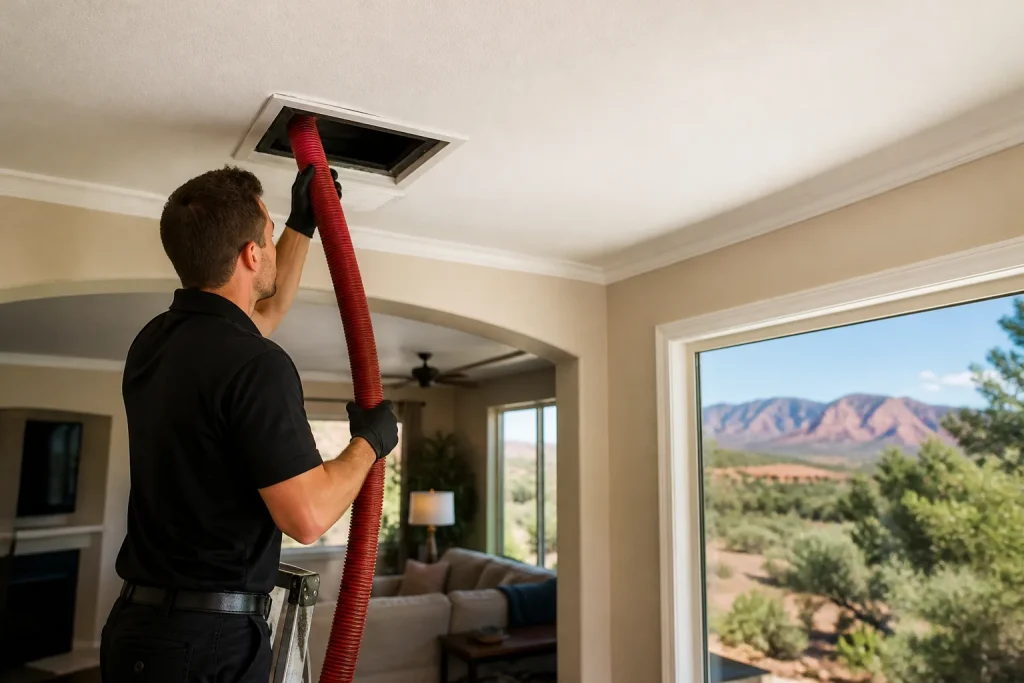
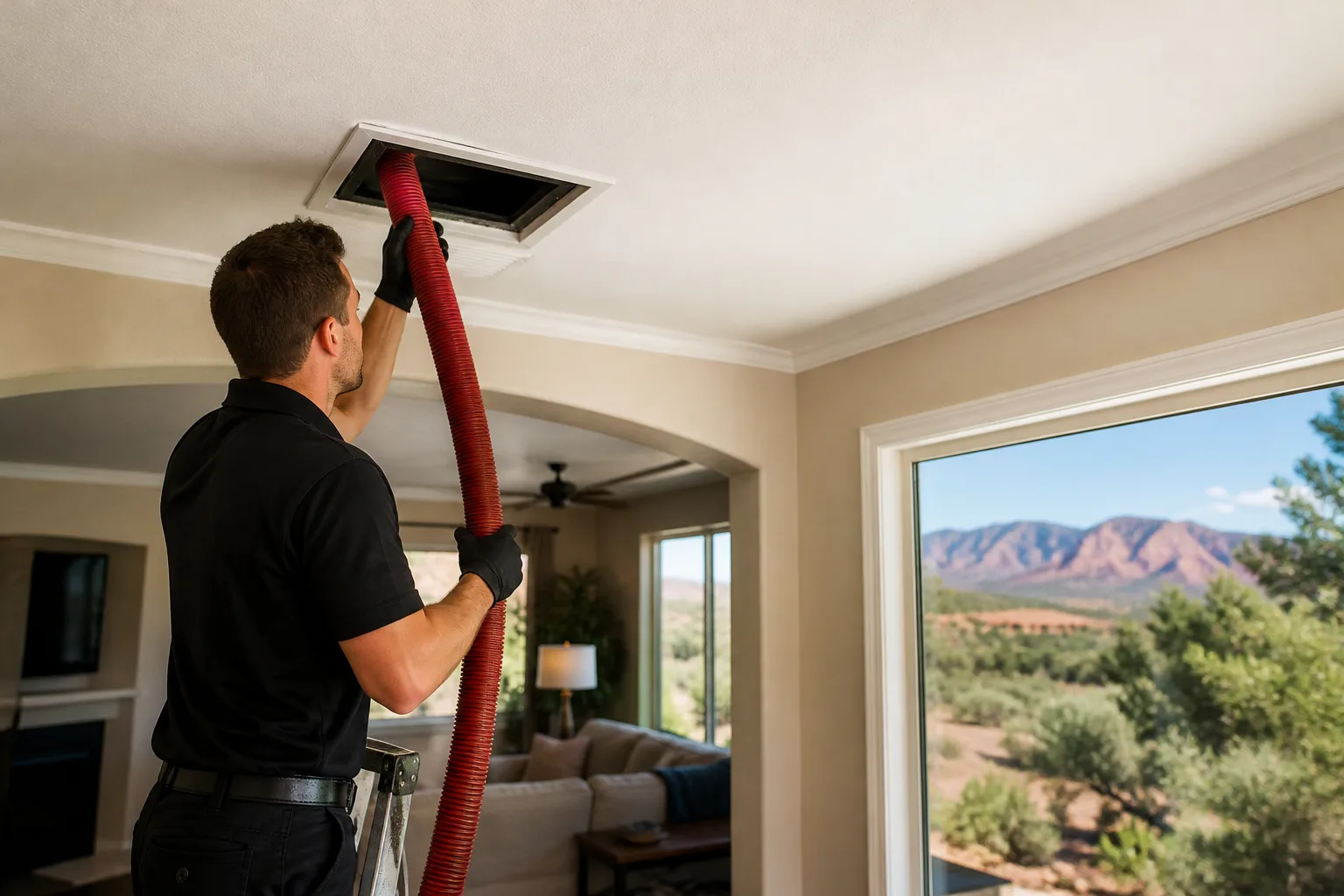
None of these devices clean a duct wall. Contact cleaning, meaning a rotary brush physically scrubbing the interior while a HEPA vacuum pulls the dislodged material out, is what removes the accumulated layer. That’s the work behind our air duct cleaning service in St. George, and it’s the step most Honeywell owners skip because the hardware looks like it’s already doing the job.
Why does a bypass humidifier matter in St. George’s desert climate?
Honeywell bypass humidifiers are common in St. George homes for a good reason: summers here are dry, and adding moisture to heated or cooled air makes the house more comfortable and less punishing on wood floors and cabinetry. The problem isn’t the humidifier. It’s the calibration.
A bypass unit that’s running too high, or feeding a duct run that isn’t properly sealed, can push moisture into ductwork that never fully dries. In a desert climate, that’s the opposite of what you want. Dust that would stay loose and dry instead clings to duct walls, and the moisture can encourage microbial growth in areas you’d never think to check.
What we look at on a St. George job with a bypass humidifier in the system:
- Whether the humidistat is set for actual outdoor conditions, not a leftover winter setting from a colder climate
- Water panel condition and mineral scale, which is heavier here because of local water hardness
- Whether the bypass duct connection is sealed and draining correctly
- Any moisture staining, soft drywall, or musty odor near the humidifier tie-in
If the humidifier is doing its job, it adds comfort. If it’s over-delivering into a dirty duct system, it compounds the problem. That’s a conversation worth having before the next heating season.
Clean first or commission the IAQ accessories first?
Clean the ducts first. Always. Then commission or re-commission the Honeywell, Aprilaire, or other IAQ accessories once the system is clean. Doing it in the reverse order is the most common sequencing mistake we see in St. George homes.
Here’s why the order matters. A UV light or electronic air cleaner installed into a dirty duct system starts its service life fighting a particulate load it was never rated for. The media filter loads up faster, the UV lamp’s effective reach gets clouded by surface dust, and the homeowner ends up replacing components prematurely without ever seeing the benefit. Once the ducts are clean, the equipment starts from a level field.
What the correct sequence looks like on a Honeywell-equipped system:
- Inspect and document duct condition, including any disconnected or damaged runs
- Perform contact cleaning with a rotary brush and HEPA vacuum capture
- Repair any structural issues identified during cleaning, since cleaning can’t fix a disconnected run
- Replace or clean the media filter and any pre-filters
- Verify the humidifier calibration and water panel condition
- Check UV lamp function and mounting, and replace the lamp if it’s past its effective hours
- Confirm airflow and system static pressure after the work
That sequence is part of how we run a full-system visit. Cleaning, repair, and protection in one pass is more useful than cleaning alone on a home where the Honeywell hardware is meant to be the long-term air quality layer.
Could your Honeywell media filter be hiding a dirty duct system?
Yes, and it happens more often than homeowners expect. A heavy-loading media filter can make a duct system look healthier than it is. The filter is doing its job, so the dust you’d otherwise see is being caught before it reaches the return grille. But the duct walls behind it are still accumulating.
Signs a Honeywell media filter is masking a dirty duct system:
- Loading on one side of the filter only. This suggests uneven airflow through the frame, often from a duct issue upstream.
- Bypass gaps around the filter frame. Air sneaking around the filter means particulate is getting into the system unfiltered, and you’ll see dust on the return plenum and blower wheel.
- Visible dust on the blower wheel or evaporator coil. If the coil fins are matted with dust, the filter hasn’t been capturing what’s passing through.
- Short filter life. Media that loads up much faster than its rating suggests is a symptom of dirty ducts feeding it.
- Dust settling on registers or nearby furniture shortly after filter replacement. That points to particulate coming from the ducts, not the filter.
None of this is a Honeywell product issue. It’s a duct condition issue, and it’s why we look at the whole system rather than just swapping the filter. If a filter frame is bypassing, we’d rather fix that than have you pay for filters that never had a chance.
What should a technician inspect on a Honeywell-equipped system?
A standard duct cleaning checklist doesn’t cover what matters on a Honeywell IAQ setup. The technician should inspect and document the duct condition, the Honeywell hardware, and the interaction between the two, since a cleaning that ignores the accessories leaves the system half-served.
What a full inspection should include on a Honeywell-equipped St. George home:
- Duct integrity on each run feeding the air cleaner: disconnected joints, crushed flex runs, or separated trunk connections that let unfiltered air into the system
- Filter frame fit and seal: any bypass gap should be documented with a note, and photographed
- Electronic air cleaner cell condition: loaded cells, damaged collector plates, and confirm the unit is actually energized
- UV lamp hour count and mounting: a lamp that’s past its rated hours may look lit and still underperform
- Bypass humidifier water panel, drain, and calibration: scale, moisture, and whether the humidistat setting is appropriate for the season
- Blower wheel and evaporator coil condition: these are the components that tell you whether the filter has been doing its job
- Static pressure readings before and after: a clean system that still has high static pressure has a different problem to solve
We run Rotobrush contact-cleaning equipment and Nikro HEPA vacuums on these jobs, because a brush-contact clean with real vacuum capture is the only method that removes settled material from duct walls rather than pushing it around. Abatement Technologies equipment capability matters on homes where indoor air quality is a serious concern, and familiarity with the Honeywell and Aprilaire product lines means the recommendations extend beyond the cleaning visit. It’s the same professional-grade tool set used in commercial and remediation work, and it’s what makes a documented clean trustworthy.
When to call a pro
Some duct and IAQ work is fine to think through yourself, and some isn’t. Call a professional if any of these apply on your St. George home:
- You’ve just bought the house and don’t know the duct history behind the Honeywell equipment
- The media filter is loading unevenly, or you can see gaps around the frame
- Anyone in the household has asthma, allergies, or respiratory sensitivity
- You’ve noticed musty odors, moisture staining near the humidifier, or dust returning fast after cleaning
- You’re planning to replace the air cleaner, UV lamp, or media filter cabinet and want the ducts clean before the new equipment goes in
- The system has never had a documented duct cleaning
We’d rather answer a question before the work than fix a problem after it. If you’re not sure whether the ducts need attention, that’s the right time to ask.
Related services in St. George: If your dryer vent cleaning hasn’t been done in a while, it’s worth pairing with the duct work, since a clogged dryer vent is a leading household fire hazard and it’s often the same kind of lint and dust load that builds in ducts. Structural duct issues identified during cleaning are addressed through our air duct repair offering, so a disconnected run doesn’t stay disconnected after the visit.
The Bottom Line
Honeywell IAQ equipment is worth having, and the reason it sometimes underdelivers in St. George homes is almost always the duct system it’s installed in. Clean the ducts first, repair what the inspection finds, then let the hardware do its job from a clean starting point. The order matters more than the brand name on the box.
What we’d ask any St. George homeowner to check before the next service call:
- Filter loading pattern and frame seal
- Whether the humidifier is calibrated for the local climate
- Any signs of moisture, musty odor, or dust returning right after cleaning
- Whether the duct system has ever had documented contact cleaning
If you’re in St. George and need help, Ironwood Air Duct Cleaning offers free estimates. Call (855) 419-9402. We answer 24/7. Fast dispatch from 7am to 7pm, Sunday through Friday. The estimate is free, the price is set per job by the written estimate, and we photograph the ducts before and after so you can see the difference for yourself. Our technicians have up to experience, and we work with homeowners, landlords, and property managers across the St. George area. You can learn more about how we approach this work on our Ironwood Air Duct Cleaning page.
Frequently Asked Questions
There’s no single price, and any quote that sounds too low usually is. Whole-system duct cleaning is priced per job after an inspection, not per vent or per coupon. Be skeptical of a low teaser figure that grows once the technician is on site. The estimate from Ironwood is free, the price is set per job in writing before work starts, and you get before-and-after photos of your own ducts. Call (855) 419-9402 for an exact quote, estimates are free.
No, cleaning doesn’t void the warranty, but improper cleaning can damage sensitive components if the technician isn’t familiar with the hardware. The electronic air cleaner cells, UV lamp assembly, and media filter cabinet should all be handled correctly during the visit. A technician experienced with Honeywell, Aprilaire, and similar IAQ lines will know what to remove, what to protect, and what to leave in place. If you’re not sure the last cleaner understood your system, that’s a good reason to ask before booking. Call (855) 419-9402 to talk it through.
Every few years for most St. George homes, sooner if you’ve just moved in, finished a remodel, or noticed dust returning fast. Desert dust, drywall grit from construction, and normal household activity all feed the duct load. Homes with pets, allergy sufferers, or recent renovations tend to need it more often. The condition of the Honeywell media filter is one useful signal: heavily loaded filters paired with visible coil or blower dust usually mean the ducts are due. Call (855) 419-9402 and we’ll help you decide whether it’s time.
Cheaper quotes usually mean less equipment and less time on the job. A blow-and-go air wash with a shop vacuum and a hose doesn’t remove settled particulate from duct walls, and it doesn’t capture what it dislodges. Real contact cleaning involves a rotary brush system like Rotobrush and a HEPA vacuum like Nikro to capture what comes loose, so it doesn’t recirculate into your home. That’s a different job, and it’s what the difference in price reflects. Call (855) 419-9402 for an honest whole-system estimate, and it’s free.
Written by the team at Ironwood Air Duct Cleaning.
Need Air Duct Cleaning Help?
Call Ironwood Air Duct Cleaning - licensed & insured, here with fast help in St. George.
(855) 419-9402